
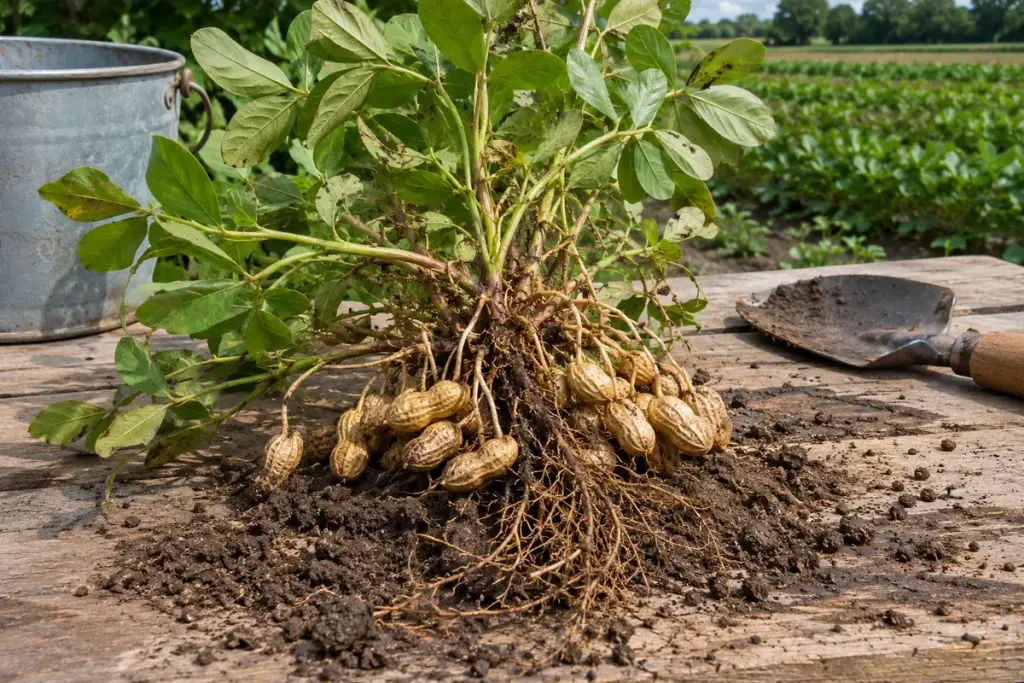
A peanut plant can flower in plain sight and still hide its developing crop. The yellow flowers appear above ground, while the familiar shells eventually develop beneath the soil. The connection between those two places is a slender structure called a peg.
After fertilisation, the developing ovary is carried downwards on this growth. Once the peg enters suitable soil, the pod develops underground. The Georgia Peanut Commission’s lifecycle explanation follows that unusual sequence. The shell is therefore a fruit formed from a flower, not a swollen root.
Observe the plant without uncovering the crop
A useful garden notebook can separate flowering from peg development. Record the first visible flowers, then look for downward-growing pegs near the plant. Photograph from the side without lifting the stems or pulling at anything that has entered the soil.
A flower date alone does not tell you that every pod will mature together. Different parts of the plant may be at different stages. That is one reason a photograph of the leaves cannot reveal the condition of every underground pod.
Utah State University Extension’s peanut-growing guide explains the relationship between flowers, pegs and underground fruit, alongside growing requirements. Use locally appropriate guidance when deciding whether your season and soil suit the crop.
Keep the vocabulary attached to the structure
For a learning activity, draw a simple line from a flower to a peg and then to a pod. Label roots separately. This prevents an easy misunderstanding when an uprooted harvest photograph shows roots, pegs and pods tangled together.
If you grow several plants, choose one for any planned harvest investigation rather than repeatedly disturbing the whole patch. Compare the visible above-ground record with what you eventually find below. The rewarding part of the exercise is seeing how a flower has led to fruit in a place you could not watch directly.
For routine crop care, preserve the surrounding soil conditions recommended by your extension service. Digging around a plant merely to check progress can interfere with the structures you are trying to observe.