
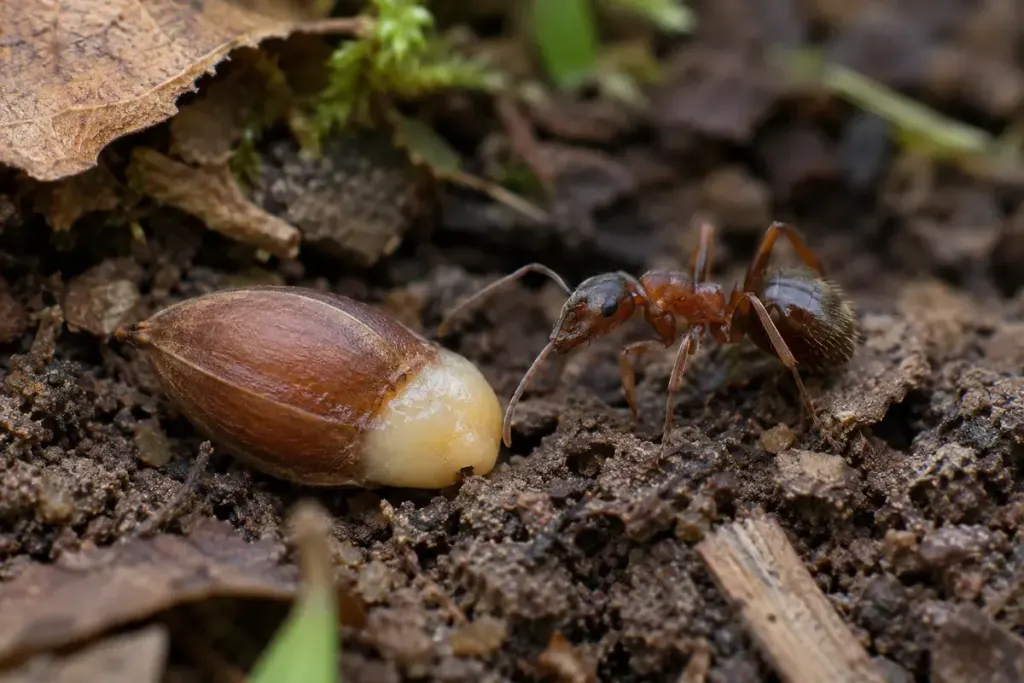
A seed may carry a small pale attachment that looks insignificant beside its hard coat. To an ant, that attachment can be the most interesting part. An elaiosome offers a food reward that can help a plant move its seed away from where it fell.
Kew’s account of ant-dispersed seeds describes ants carrying seeds, consuming the nutritious attachment and leaving the seed behind. This form of dispersal is called myrmecochory. The relationship occurs in different plant groups, but its details vary with the species and setting.
The reward and the seed have different roles
The elaiosome is not simply a tiny new leaf. It is an attachment associated with the seed, while the embryo that may grow into a plant is elsewhere within the seed structure. Keeping those parts distinct helps explain why consuming the reward need not mean consuming the whole seed.
Where a seed ends up matters. Being carried is only one stage; survival and germination depend on the conditions that follow. Avoid turning an observed journey into a claim that a new plant will certainly appear.
Watch without rearranging the experiment
If you encounter ants moving seeds naturally, note the plant nearby, the ground surface and the direction of travel. A photograph can record the attachment without opening the seed or disturbing the nest. Do not handle unidentified seeds or offer them to children or animals; some plants have highly toxic seeds.
For a field notebook, separate “ant carried a seed-shaped object” from “identified species carrying a seed with an elaiosome.” Identification may need an expert or a reliable botanical reference.
Look for repeated observations rather than assuming one ant explains the entire population. Were other seeds ignored? Did the ant drop its load? Was the object carried into a nest or merely moved a short distance?
These small details make the observation useful. They also prevent an appealing story about cooperation from hiding the uncertainty of what happened after the seed left your view.