
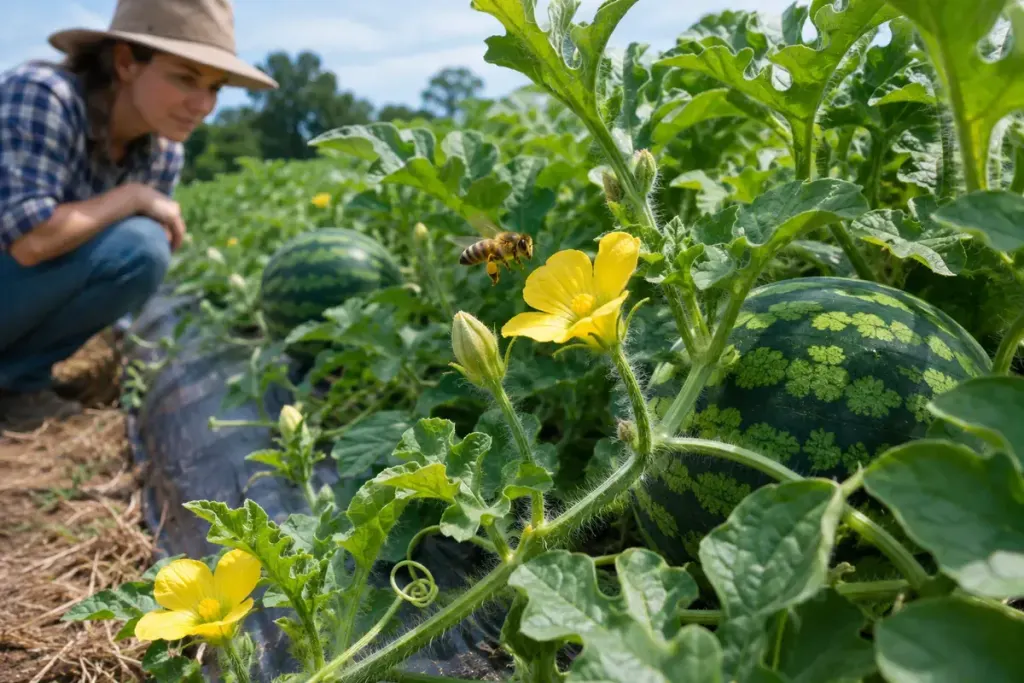
A seedless watermelon is not a fruit that develops without pollination. For a grower, that distinction belongs near the top of the planting plan: the crop needs a suitable source of viable pollen as well as insects that carry it to receptive flowers.
University of Georgia Extension’s watermelon production guide explains that commercial seedless types are triploids. Their chromosome arrangement prevents normal seed formation, and their own pollen supply is inadequate. A compatible diploid watermelon is therefore grown as a polleniser.
Two similar words, two different jobs
The polleniser is the plant supplying pollen. The pollinator is the insect moving it. Adding bees cannot compensate for having no suitable pollen source, just as planting the source does not guarantee enough insect visits.
UGA’s explanation of seedless-watermelon genetics provides background on why a seedless crop can still begin with planted seed and still require pollination. Soft undeveloped seed structures can also remain in fruit sold as seedless.
Plan the companion, not just the main variety
Ask the seed supplier or local extension adviser which polleniser and arrangement suit your cultivar and conditions. Flowering needs to overlap. Avoid copying a row pattern from a commercial field without checking whether it fits a small garden, a different variety or a different growing season.
Mark the plants in your garden plan so you know which ones serve each role. Keep the packet names and planting dates. Those simple records make later questions about flowering and fruit set much easier to answer.
Observe before assigning blame
If fruit set is disappointing, record flowering times, insect activity and recent weather alongside watering and plant condition. A single quiet morning does not establish that pollinators are absent all day, and one failed fruit does not prove the polleniser variety is wrong.
Use the observations to seek local advice rather than making several changes at once. Protect visiting insects by following pesticide labels and appropriate pollinator guidance. The practical lesson is that “seedless” describes the eating experience, while successful production still depends on a coordinated biological process.