
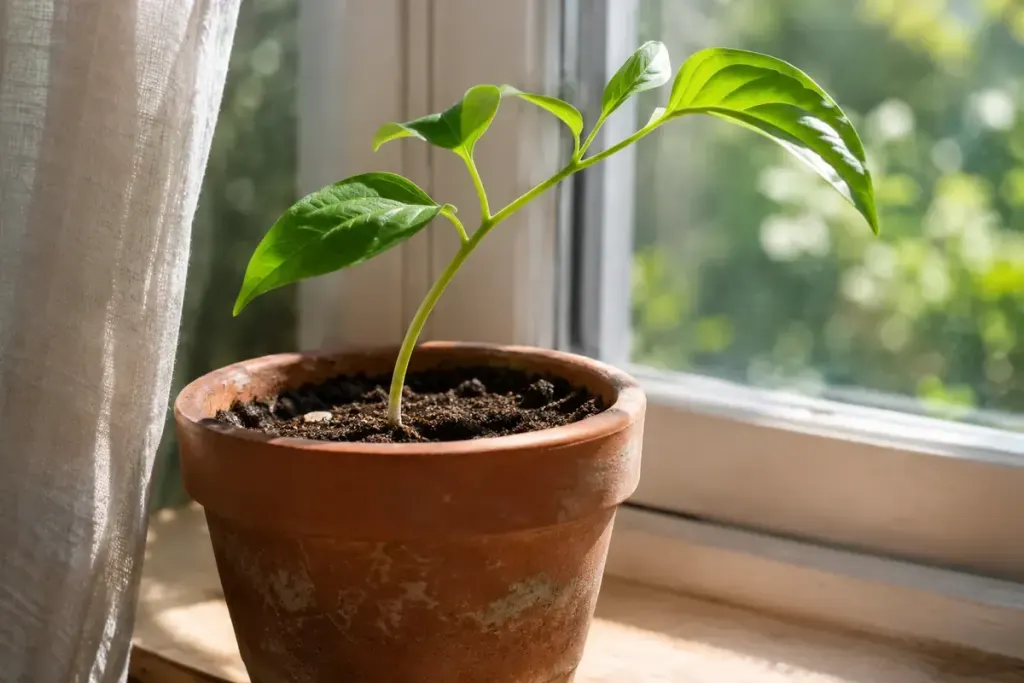
A young plant beside a window may begin upright and gradually lean toward the glass. It is tempting to describe this as the plant “looking for the sun.” Phototropism gives a more precise explanation: growth responds to the direction of light.
OpenStax’s account of plant sensory responses explains how light perception and growth regulation can produce bending in shoots. Unequal elongation on opposite sides changes the shoot’s direction. It is a growth response, not a stem turning on a hinge like a desk lamp.
Watch change rather than one final shape
A bent seedling does not prove its history. It may also have been knocked, grown under uneven conditions, or already leaned when it was moved. An observation becomes more useful when the starting position and subsequent conditions are recorded.
For a simple classroom or home-growing observation, use healthy seedlings of the same kind and a consistent watering routine. Mark the pot’s orientation, photograph from the same position, and note where the main light comes from. Keep other conditions as similar as practical. Do not repeatedly rotate a pot while trying to measure the response to one direction of light.
Record what is visible: “the upper stem curved toward the window over the observation period.” Avoid jumping straight to a numerical claim about growth rate if the photographs do not support a reliable measurement.
What this means for raising seedlings
A strong lean can prompt a review of light distribution, but phototropism alone is not a diagnosis of every growing problem. Plant species, developmental stage, overall light availability, and the growing environment all matter.
Nor should this response be confused with every form of sun-tracking movement. The familiar image of a plant following the sun describes a broader set of behaviours than the gradual bending of a seedling toward a side-lit window.
The useful habit is to connect a plant’s shape with a record of its conditions. That turns an attractive time-lapse idea into a small, understandable observation about how living shoots grow.