
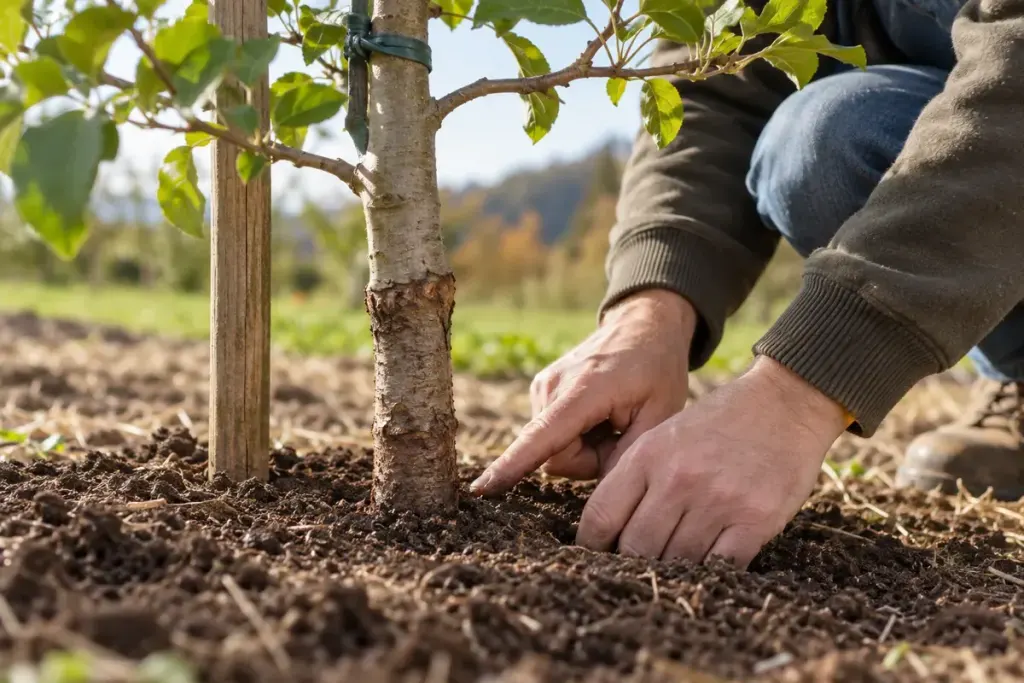
A swelling low on a young fruit tree’s trunk can look like a blemish to hide beneath the soil. On a grafted tree, it may be the graft union—the join between the chosen variety and its rootstock. Burying it can change how the tree develops.
University of Minnesota Extension’s apple-growing guidance explains that if the scion forms its own roots, the intended size control from the rootstock can be lost. Its planting instructions are for apples in that context; other fruit types and nursery systems need their own guidance.
Identify the parts while the tree is still easy to inspect
Find the roots, the lower trunk and the graft union before placing the tree. Keep the nursery label so that the variety and rootstock remain identifiable. If the join is unclear, ask the supplier rather than estimating its position from a photograph of a different tree.
Use the recommended relationship between the union and the final soil level for that tree. A temporary mound or loose backfill can settle, so think about the finished planting position rather than only how it looks before watering.
Do not pile mulch against the trunk to disguise an exposed join. Mulch placement and planting depth are separate decisions, and the visible graft does not need to disappear for the planting to look complete.
Make the planting record useful next season
Photograph the tree with the ground level visible and record the planting date, variety and rootstock. Include the supplier’s instructions. If growth later seems unexpected, those details give an adviser something more concrete than “a dwarf tree bought last year.”
For an established tree whose union appears buried, obtain local horticultural advice before excavating around major roots or changing the soil level. A corrective action can create its own damage.
The graft union is a reminder that a fruit tree is often a combination of two plants selected for different jobs. Recognising that join turns planting depth from a cosmetic choice into an informed part of orchard care.