
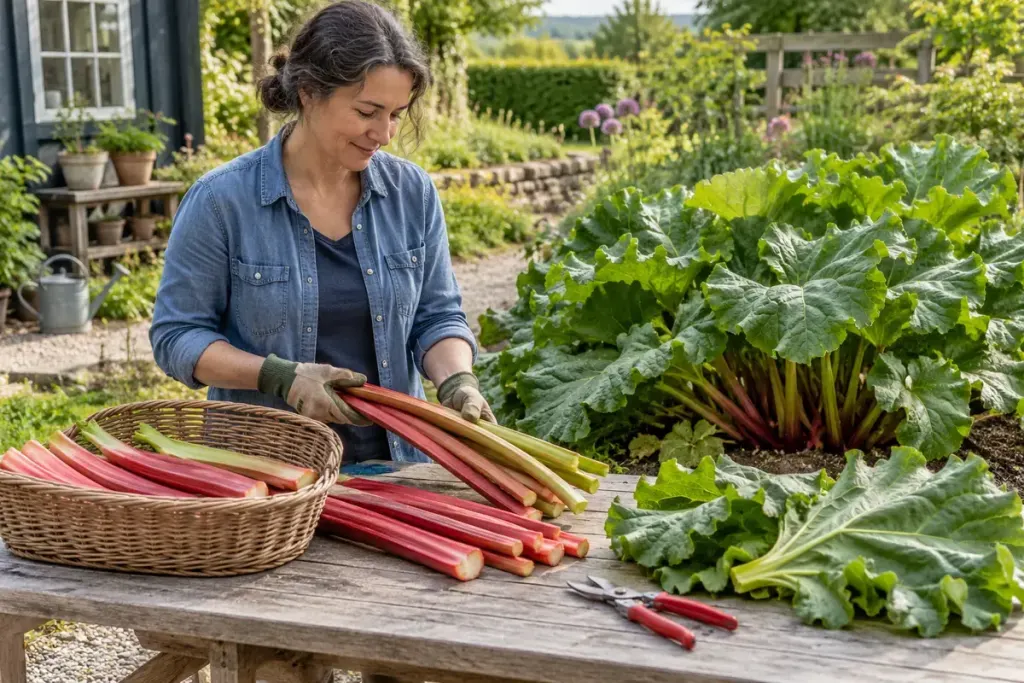
Rhubarb is often discussed as though the whole plant were an ingredient. It is not. The stalks used in cooking are distinct from the leaves, which should not be treated as food.
The Royal Horticultural Society’s rhubarb guide explains cultivation and harvesting and warns about the poisonous leaves. Use a positively identified culinary rhubarb plant. An unfamiliar plant with similar-looking stems is not a safe substitute.
Plan the harvest before filling the kitchen basket
Check the plant’s age, condition, and the local growing season against reliable horticultural guidance. A newly established or stressed plant should not be treated like a vigorous, mature clump. Avoid turning a calendar month from another climate into an automatic instruction for your garden.
Prepare a clear place to separate the harvested stalks from their leaves. Keep leaves out of the food-preparation area and away from children or animals that might investigate them. Do not use them as an experimental wrap, garnish, or stock ingredient.
For a practical garden record, note the plant, the harvest date, and whether you left enough growth for it to continue developing. If several people share the garden, label the crop and explain which part is used. A familiar plant to one volunteer may be unfamiliar to the next.
In the kitchen, follow a suitable recipe for the stalks and remove damaged material as appropriate. Do not assume that a redder stalk is a different permission to eat the leaf, or that cooking turns every plant part into food.
The simplest useful distinction is also the most important: growing instructions concern the whole plant, while the recipe concerns the edible stalk. Keep those two contexts separate from the moment of harvest through to preparation.