
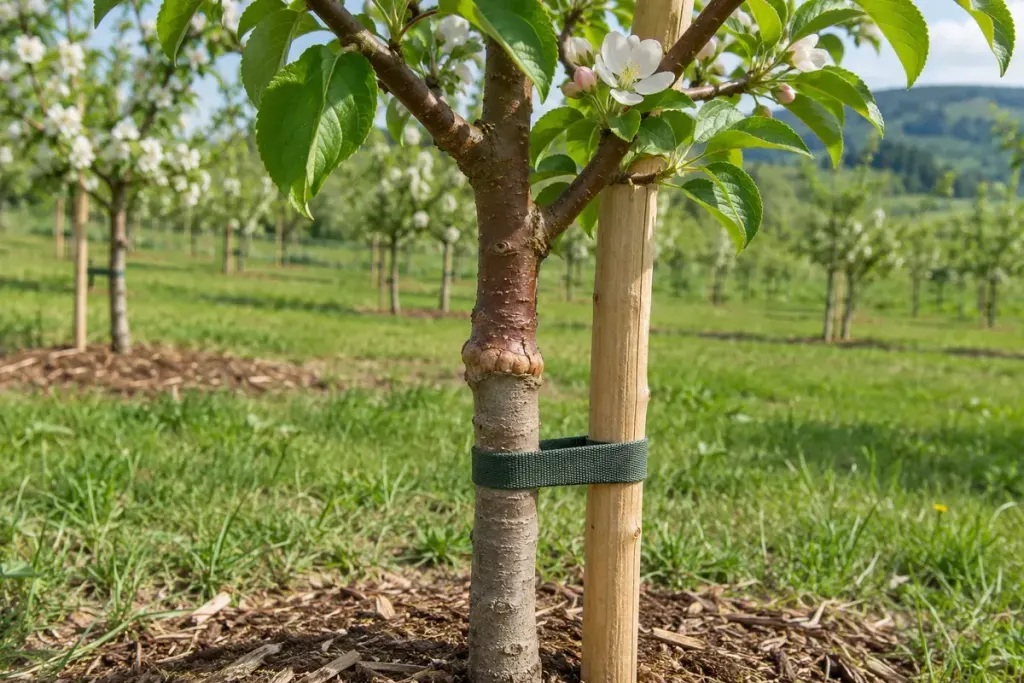
A graft that produces new growth has cleared an important early hurdle, but that does not guarantee a lasting partnership between rootstock and scion. Some incompatibilities become evident only later, after the plant has appeared to establish.
The Royal Horticultural Society’s graft-failure guidance describes possible causes and signs of trouble. Cornell’s graft-compatibility notes explain why a successful initial union and long-term compatibility are different questions.
Keep the plant’s identity with its history
Record the scion cultivar, rootstock and planting date when the tree is acquired. A nursery label can fade or disappear before a delayed problem becomes visible. Keep the purchase details and any supplier advice in the same record.
When observing the union, note changes over time rather than diagnosing from one unusual-looking swelling. Photograph the same side with a scale reference where practical. Also record growth, leaf condition and recent weather or physical damage.
Several problems can look similar
Weak growth or damage near a union can have causes other than incompatibility. Disease, mechanical injury and growing conditions need consideration. A visible difference in trunk thickness does not, by itself, establish that the graft is failing.
Ask an appropriate horticultural adviser or the supplying nursery to review the plant and its history. Do not cut into a living union merely to inspect it, and do not remove support or make major changes based on a photograph found online.
Where a tree presents a risk of falling or breaking, keep people away and obtain suitable professional advice. Plant health and structural safety should not be reduced to a single gardening label.
The practical lesson is to preserve the pairing information and observe the whole tree. Delayed incompatibility is a real possibility, but a sound decision comes from identifying the actual problem rather than assuming that every late setback begins at the graft.