
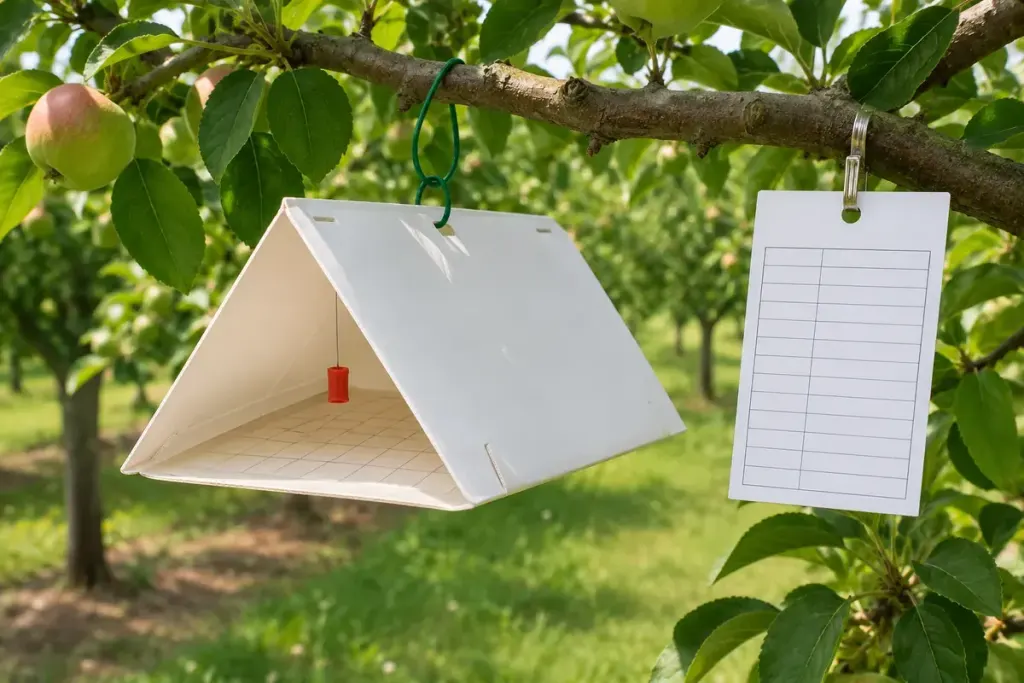
A sticky trap with insects on it is not automatically answering the question you intended to ask. With pheromone monitoring, the target species, lure, trap type and placement all belong to the monitoring method.
The University of California’s prune pheromone-trap guidance and pear guidance illustrate why recommendations are crop- and pest-specific. A count only becomes useful when you know what was deployed and how the programme expects it to be read.
Make the trap identifiable in your records
Give each trap a location identifier. Record the intended pest, lure product, installation date and lure-replacement date. Keep the label information; “the small packet from the shed” is not enough to reconstruct a monitoring season.
Use the placement and servicing instructions for the relevant pest and local programme. Do not transfer a height, spacing or replacement interval from a different crop simply because the trap looks similar.
A catch is a measurement with conditions
Suppose one trap catches fewer insects after a lure change. Possible explanations need investigation: population change, a different lure, placement, servicing or identification may all affect the comparison. The number alone does not establish that the crop is free of damaging pests.
Likewise, catching insects is not the same as proving economic damage or deciding that a pesticide treatment is necessary. Use crop-specific thresholds and qualified local advice where an intervention is being considered.
- Count and identify the relevant insects consistently.
- Record the check date even when the catch is zero.
- Note damaged traps, lost lures or changed locations.
- Keep monitoring records separate from any treatment decision.
If identification is uncertain, retain a clear photograph and ask an extension service or qualified adviser. Avoid turning an uncertain identification into a confident pest alert.
The trap is most useful as part of a repeatable observation method. Consistent records make it possible to interpret a change, rather than merely notice that something has stuck to a card.