
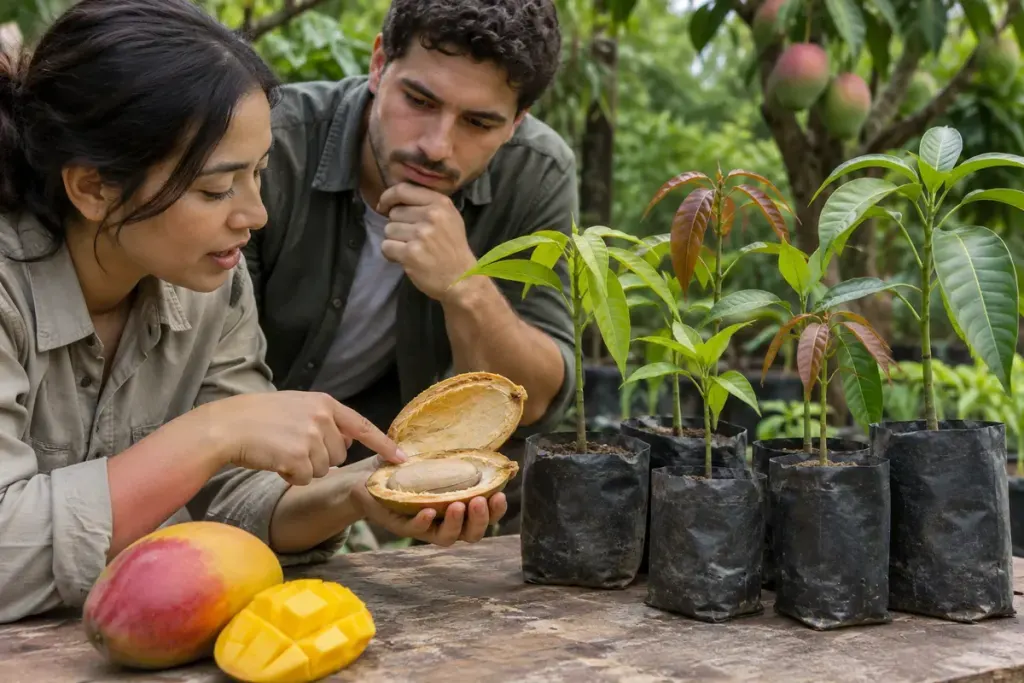
A mango seed that produces several seedlings can surprise a home grower. It may reflect polyembryony: the presence of more than one embryo in the seed. That is different from assuming that every shoot is a new branch of one ordinary seedling.
Mango varieties differ in their seed behaviour. The distinction matters when the goal moves beyond enjoying germination to growing a tree with predictable fruit.
A seedling is not automatically a named variety
University of Florida IFAS guidance distinguishes monoembryonic and polyembryonic mango varieties. It explains that polyembryonic varieties generally come true from seed, whereas monoembryonic varieties require vegetative propagation to reproduce the same variety reliably.
The word “generally” deserves attention. A supermarket fruit may arrive without trustworthy information about its cultivar, and the number or size of visible shoots alone is not a full genetic identification. Avoid labelling every resulting plant as a verified clone of a named parent.
A botanical-garden account of mango propagation by Fairchild Tropical Botanic Garden also notes that seedling trees take longer to fruit than grafted trees. A lively pot of seedlings does not establish when, or how well, it will crop in your climate.
Keep a propagation record
Write down the source of the fruit, any cultivar name actually supplied, the sowing date, and the number of separate seedlings observed. Photograph the base before transplanting so later changes do not erase the early record.
For a small experiment, the aim can simply be learning how seedlings develop. If the aim is a particular fruit quality or a manageable tree for a limited space, ask a reputable nursery about a suitable grafted plant and local growing conditions.
That separates two worthwhile projects: raising an interesting seed and establishing a dependable fruit tree. They can overlap, but the success of the first does not automatically prove the second.