
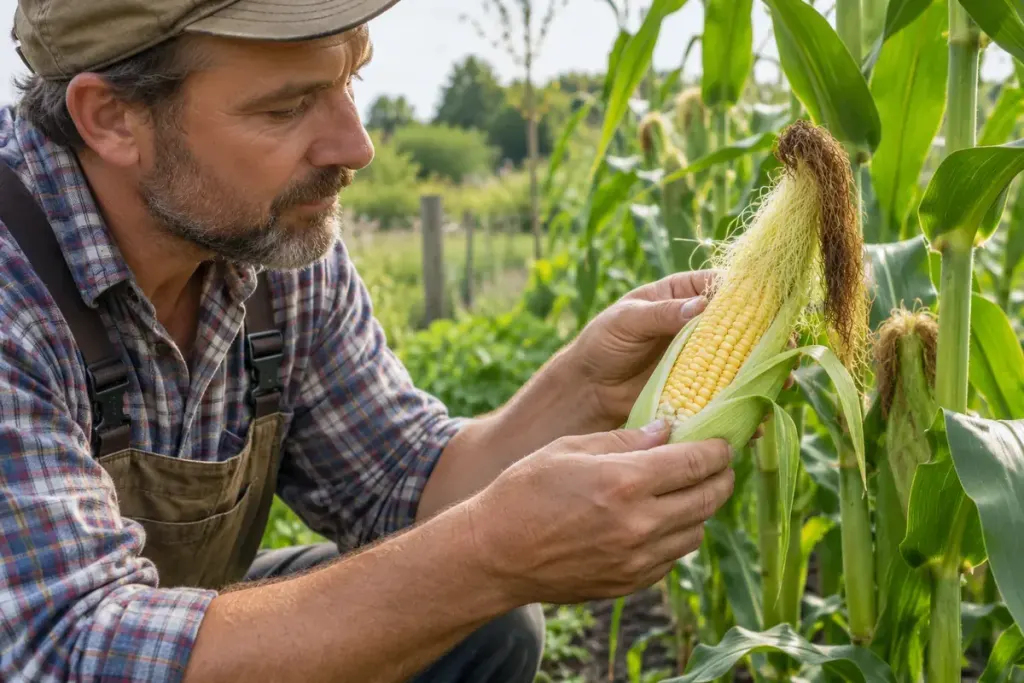
Brown silks suggest a sweetcorn cob deserves attention, but they are not the whole harvest test. Variety, planting date and weather affect development. The useful question is whether the kernels have reached the stage you want to eat.
University of Minnesota Extension’s sweetcorn guide describes harvesting when kernels are full and release a milky liquid when squeezed. This is sweetcorn guidance, not the dry-grain maturity test used for other corn crops.
Inspect a likely cob
Choose a cob whose appearance and expected maturity suggest it may be ready. Open only enough husk to examine a small area rather than stripping every cob in the row. Check kernel development, not merely the cob’s outside size.
A watery, underfilled kernel and a firm, starchy one represent different stages. Use the variety’s guidance alongside the observation. Do not assume the first cob you open proves that every plant in the patch is ready on the same day.
Record the variety, sowing date and the result of the check. Over time, those notes can help you recognise your own crop’s sequence without turning last year’s harvest date into a fixed rule.
Plan what happens after picking
Harvest only what you can handle appropriately. Prepare, cool or store the crop according to suitable food-safety and variety guidance. Sweetness and texture can change after picking, so leaving a harvest in a warm shed while deciding what to do with it defeats careful timing.
If cobs show damage, mould or other signs of deterioration, do not treat cooking as an automatic remedy. Sort the harvest responsibly.
The silk gives you a reason to look; the kernels give you more direct evidence. Bringing those observations together is more reliable than choosing between “the packet says today” and “the outside looks brown”.