
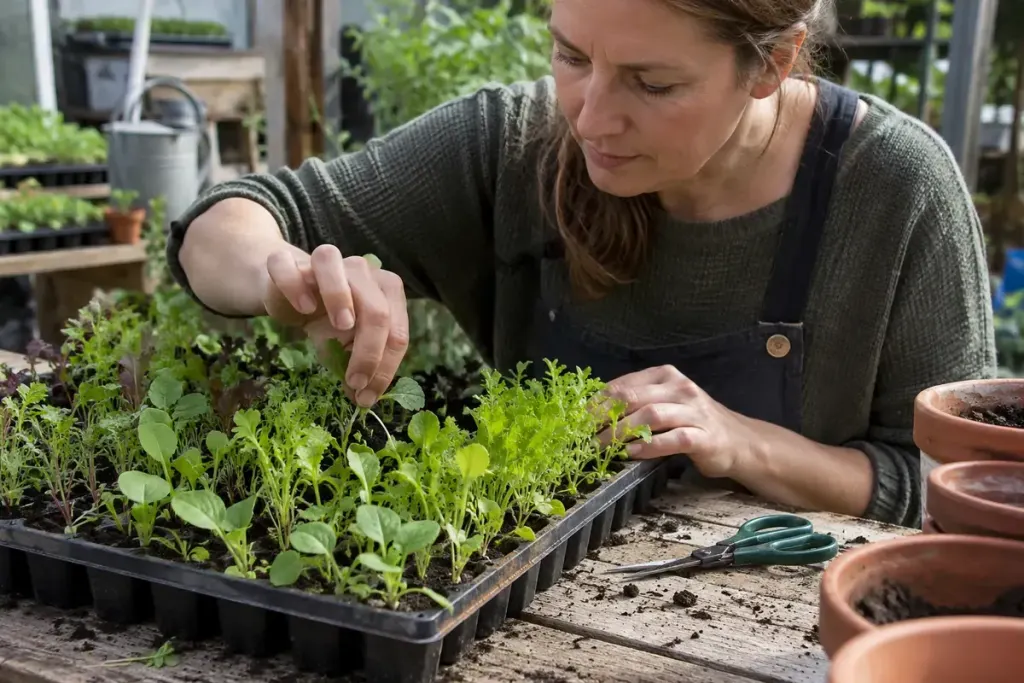
A row full of new seedlings is satisfying to see. Removing some can feel wasteful, especially after waiting for germination. But a crowded row is not the same as a productive mature row. The plants need room for the crop you intend to harvest.
Find the spacing guidance for the exact vegetable and variety before thinning. The distance between rows and the distance between plants within a row are separate measurements. Do not use one number for both simply because it is the first one printed on the packet.
Choose what will remain
The Royal Horticultural Society’s seed-sowing guide explains that thinning reduces competition for light, water, and nutrients, and that suitable distances vary by crop. It also distinguishes seed leaves from the first true leaves when discussing young seedlings.
Look along the row before removing anything. Identify healthy plants at roughly the intended intervals rather than taking out random seedlings and discovering a large empty gap afterwards. A marked stick can help make the spacing easier to see.
Be gentle around the plants you keep
Use a method appropriate to the crop and growing conditions. Where pulling a seedling would disturb closely entangled roots, seek crop-specific advice about pinching or snipping unwanted growth at soil level. Avoid tugging through a cluster while holding the neighbouring plants by their stems.
Some crops can be thinned progressively, while others need their intended spacing earlier. Do not assume every removed seedling is edible or suitable for transplanting. Check the crop guidance, seed treatment information, and growing conditions before considering either use.
Afterwards, note what was sown and how much thinning it required. That small record can improve the next sowing: a steadier hand, a different sowing method, or fewer seeds may reduce the work. The aim is not to preserve every germinated seed, but to give the remaining plants a realistic place to grow.