
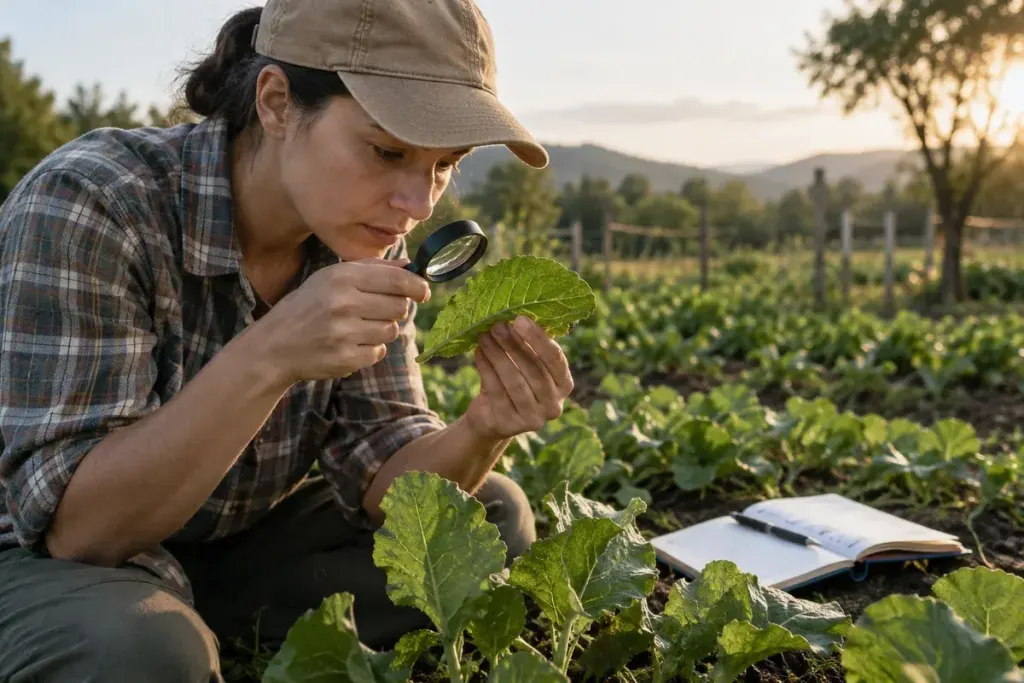
A damaged leaf attracts attention. The insect sitting on it attracts blame. Yet the insect may not be responsible, and the damage may have happened days before it arrived.
A short observation diary slows that leap from sighting to treatment. It gives you and a local agricultural adviser a clearer account of what is happening across the crop.
Record the plant and the pattern
Note the crop, variety if known, growth stage, date and precise area affected. Describe the symptom before naming a cause: holes, yellowing, wilting, marks on fruit or a change in new growth. Include whether it affects one plant, a row edge or scattered areas.
Photograph the whole plant, the affected part and a close view with a size reference when safe and practical. A close-up alone can hide useful context such as which leaves are affected or whether neighbouring plants look similar.
Keep observations separate from guesses
Use two columns. In the first, write what you saw. In the second, write a possible explanation with a question mark. “Three insects on the underside of one leaf” is evidence; “these insects caused the problem” requires further identification.
The University of Minnesota Extension diagnostic tools demonstrate a structured approach to identifying plant problems. Their regional examples are not a substitute for advice suited to your crop, climate and local pests.
Return to the same observation points
Choose a repeatable route and note whether damage is expanding, stable or confined to older growth. Record recent weather, irrigation changes and any treatment already applied. Do not change several management practices at once and then assume the last one caused improvement.
A simple entry might read: “Tuesday, north edge, five plants checked; marks on older leaves, new growth unchanged; photograph numbers 12–16.” This illustrative format is more useful than “pests worse,” because a later visit can be compared with it.
Use the diary to choose the next question
Send the record to a qualified local adviser or extension service when identification is uncertain or damage is significant. Ask what evidence would distinguish the likely causes and whether intervention is warranted.
If a pesticide is advised, follow local registration, label requirements and professional guidance. Do not select a product from an image match alone. The diary’s purpose is not to delay a necessary response; it is to make the response fit the problem and to leave a record against which its effect can be evaluated.