
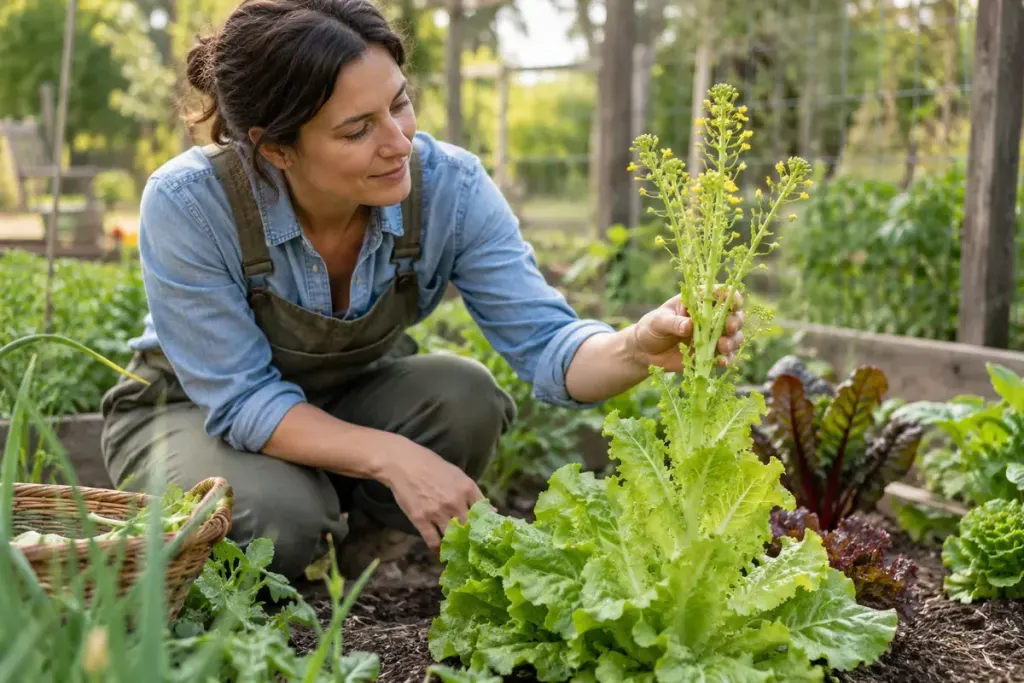
The lettuce that stayed low and leafy is suddenly sending a stem upward. That change is a reason to inspect its growth, not automatically a sign that it needs more fertiliser.
The Royal Horticultural Society’s bolting guidance explains premature flowering in vegetables and the role of growing conditions. For a crop grown for leaves, the shift toward flowering changes what you can reasonably expect from the plant.
Look at the whole plant
Compare the centre with photographs or observations from earlier in the season. Note stem extension, changing leaf form and any developing flower structures. Keep the variety name and sowing date with the record; “lettuce” covers plants selected for different uses and conditions.
If the crop no longer gives the leaf quality you want, cutting the tall stem is not a dependable way to restore its earlier growth stage. Decide whether to remove it for another crop or leave a suitable plant for observation or seed-related learning, with realistic expectations.
Use the experience for the next sowing
Review the seed packet’s recommended season and local growing advice. Consider whether the plants experienced unsuitable temperatures, crowding or inconsistent care. Do not assign the cause from one visual symptom alone; several conditions can coincide.
An illustrative garden record might say: “Variety A, sown in late spring, began extending its central stem after a hot period; watering was irregular while we were away.” This is a useful observation. It is not proof that one hot afternoon caused the change.
For future harvests, a series of appropriately timed sowings may be more manageable than relying on one batch to remain at the same stage indefinitely. Choose varieties and schedules suited to your region rather than copying a calendar from a different climate.
Keep one photograph of the early signs. Recognising the transition sooner helps you make a practical harvest and replacement decision, instead of repeatedly treating normal plant development as a mystery nutrient problem.