
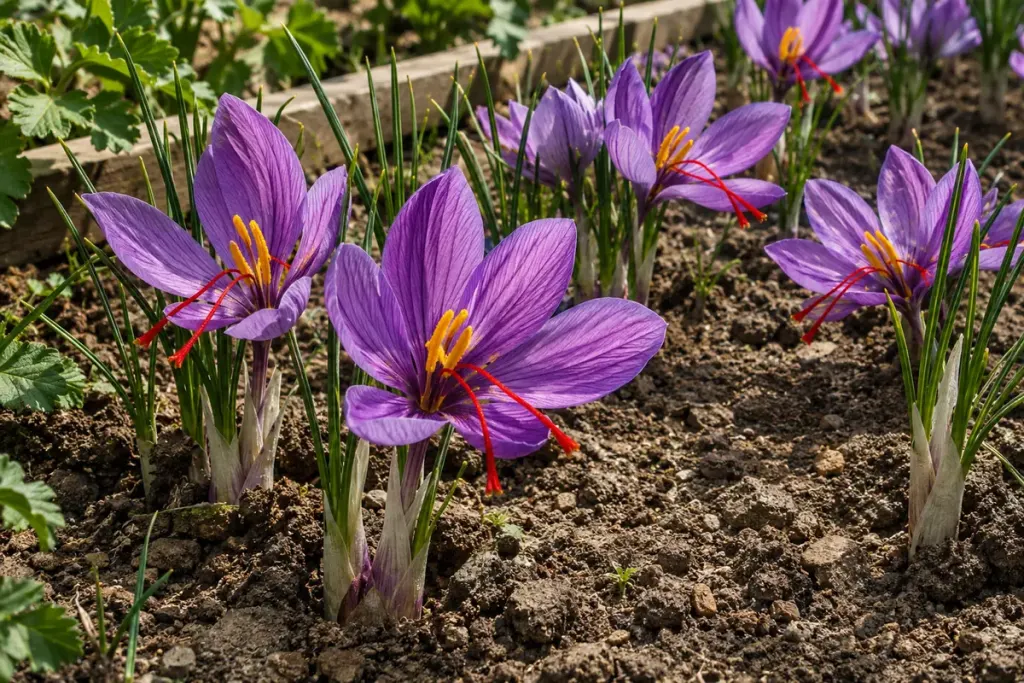
A small bowl of saffron threads represents many flowers and a surprising amount of careful handwork. Before planting a large area, it is worth learning the crop’s cycle on a scale you can observe and harvest well.
Saffron comes from the red stigmas of Crocus sativus. The University of Vermont’s production factsheet stresses purchasing correctly identified corms. “Autumn crocus” is not a sufficiently precise buying description: plants sold under similar common names are not automatically edible saffron.
Start with the growing material and the site
Use a reputable source that identifies the species and provides corm information. Record the batch, planting date and condition on arrival. Check regional growing guidance for your climate, drainage and planting arrangements; a calendar developed for Vermont should not be copied unchanged into a different region.
The crop has a sequence of flowering, leaf growth, corm development and dormancy. UVM’s visual production cycle is a helpful overview and explicitly notes that timing varies with climate. An apparently quiet bed during dormancy is not judged in the same way as a bed expected to be actively growing.
Count the harvest before estimating the income
For a first trial, keep a record of corms planted, flowers collected, time spent separating stigmas and the final properly dried crop. These observations tell you more about your own site and labour than multiplying a retail spice price by an optimistic yield found online.
Use the UVM production resources and appropriate local agricultural advice for harvesting, drying and handling. The crop is the stigma, not the whole purple flower. Correct identification and food-safe handling matter throughout; do not harvest lookalike plants from an ornamental planting.
A useful first-season goal is a reliable notebook, not a commercial forecast. Did flowering coincide with a week when someone was available to harvest? Could the drying and storage arrangements handle the amount collected? Which part took longer than expected?
Those answers make the next planting decision more grounded. Expanding a crop is easier to assess after you have followed its full cycle and measured the work involved at your own site.