
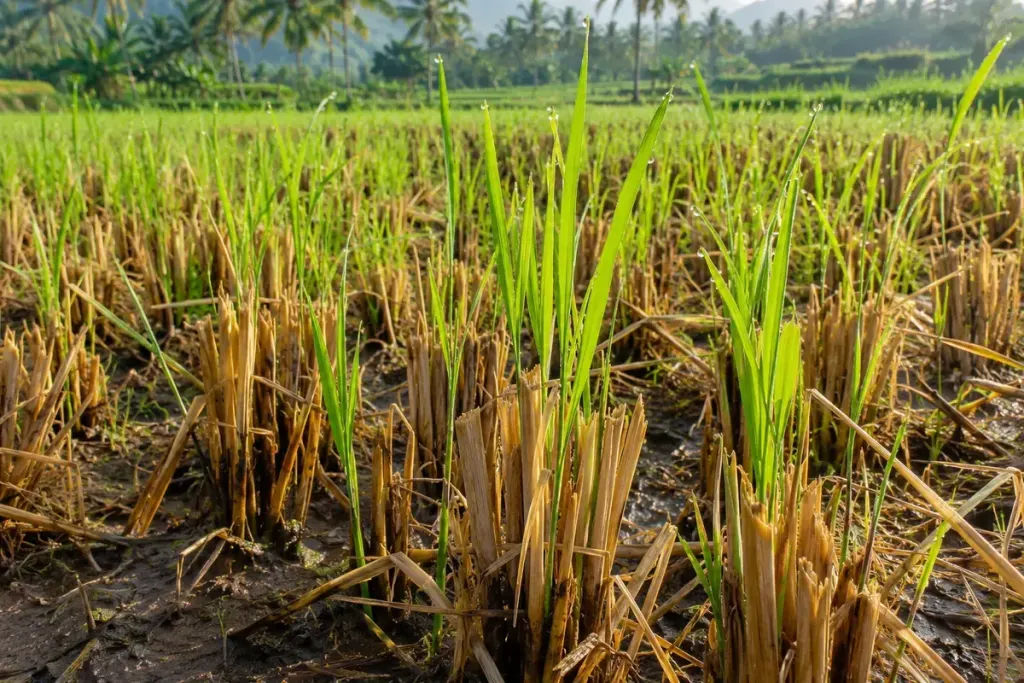
After a rice harvest, green shoots can emerge from the remaining stubble. In a ratoon system, that regrowth is managed as another crop. The starting point is the existing plant base, rather than a newly sown or transplanted stand.
That makes the first harvest part of the next crop’s establishment. The condition of the stubble, the surviving buds and the time left in the growing season all deserve attention before a grower treats ratooning as an extra harvest.
A research review of ratoon rice in the tropics describes variable performance across environments. It is a useful warning against taking a successful result from one location as a yield promise for another.
For a conventional harvest plan, the remaining stalk may mainly be viewed as residue to manage. In a ratoon plan, it also carries the potential for new shoots. Mechanical damage and the cutting arrangement therefore become questions about the living crop that remains.
Research on stubble height and ratoon-rice quality illustrates why the chosen height belongs to a wider agronomic decision. The experiment’s conditions matter; a measurement from a paper is not a universal setting for every variety and field.
Before a local trial, discuss variety suitability, harvest timing, water availability and crop nutrition with an agricultural adviser familiar with the area. Use that advice to define a small, manageable comparison rather than changing the whole farm on the strength of a headline.
Keep a record that explains the result
Note the main-crop harvest date, variety, stubble condition and subsequent management. Photograph representative parts of the trial, including weak patches. Record regrowth timing and the eventual harvest separately from the first crop.
A total grain figure alone will not reveal whether an apparently good second crop required more labour, water or time than expected. Keeping the inputs alongside the result makes the experiment useful for the next season.
Ratooning is an interesting way to use a rice plant’s capacity to regrow. Its practical value comes from matching that capacity to the local field and calendar, not from assuming that every harvested rice field is ready to produce the same second crop.