
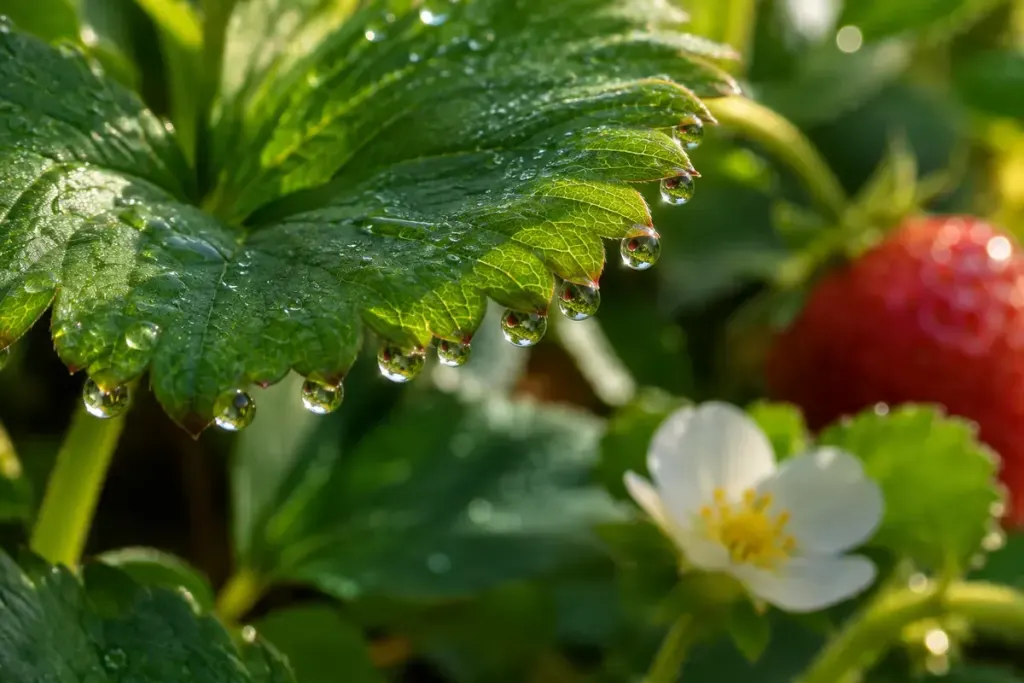
Small droplets lined up along a leaf’s edge can look as though someone carefully watered each tip. Sometimes the plant itself has released that liquid. The process is called guttation, and it differs from dew settling from the air onto a cool surface.
Michigan State University’s grape guidance describes droplets forming at serrated leaf tips when wet soil and conditions that limit evaporation allow positive pressure to develop in the vine. The liquid may leave deposits when it dries.
Notice where the droplets appear
Guttation is associated with specialised structures called hydathodes, often at leaf tips or margins. An Iowa State Extension discussion of grape guttation describes the release of water and minerals through these structures under moist conditions.
That mechanism gives an observer a useful clue: repeated droplets at particular edge points deserve a different question from a general film of moisture across many surfaces. It is a clue rather than a complete diagnosis. Rain, irrigation, condensation and other substances can also leave a leaf wet.
Make a short record before changing the watering
Note the time, recent rain or irrigation, the condition of the growing medium and where the droplets occur. Photograph the whole leaf as well as the edge. Revisit the plant later to see what remains after the liquid has dried.
Do not taste the droplets. Appearance does not establish that water on a plant is suitable to drink, particularly where treatments or contaminants may be present.
A visible droplet is not a universal instruction to stop watering every plant. Nor does it prove that roots are healthy. Watering decisions need to account for the crop, soil or growing medium, drainage and the wider condition of the plant.
Separate the phenomenon from accompanying symptoms
MSU describes guttation in its grape example as a physiological condition that is not harmful in itself. If a plant also has persistent wilting, damaged leaves or poor growth, those observations need their own assessment rather than being explained away by the droplets.
For a grower’s notebook, “droplets at serrated tips on a damp morning” is a strong first entry. It records what happened without turning one interesting water process into a guessed disease or a one-size-fits-all irrigation rule.