
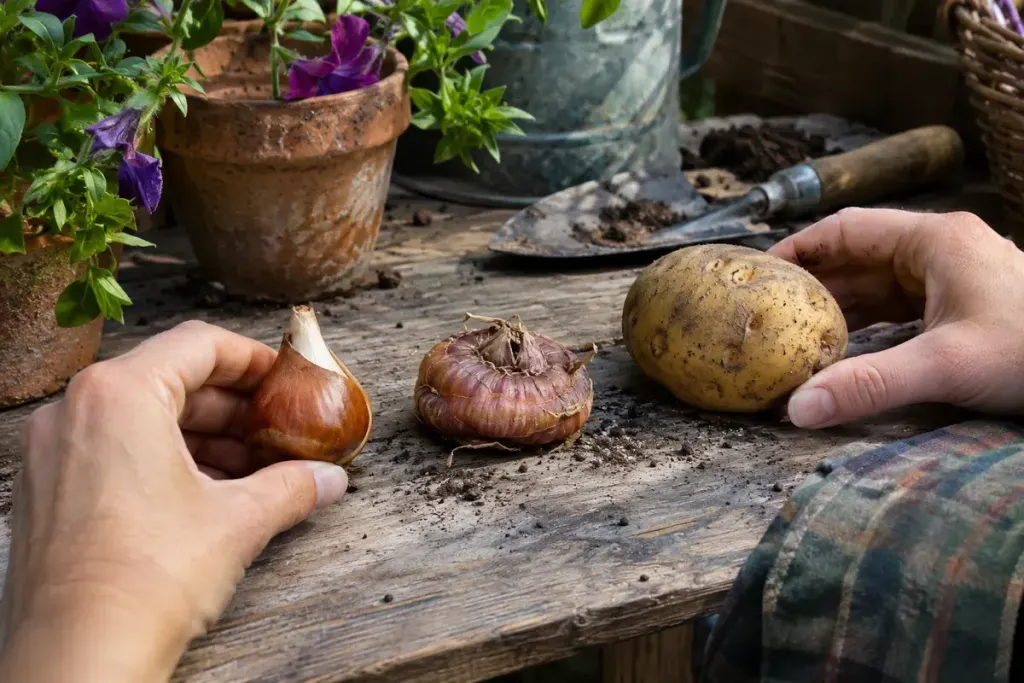
A garden-centre shelf may group several dormant plants under “bulbs,” even when their underground structures are quite different. That convenient shopping label can become confusing when you try to follow advice about planting or dividing them.
The RHS growing guide distinguishes true bulbs, corms, tubers and rhizomes while explaining that “bulbs” is often used broadly in gardening. The structures all help plants store resources, but they are not interchangeable objects.
Look for the kind of structure
A true bulb contains fleshy storage leaves or scales around a short stem. A corm is a swollen stem structure. Tubers can be associated with stems or roots, depending on the plant, while rhizomes are stems extending horizontally. The University of Minnesota’s planting guide gives examples and illustrates why the broad retail category needs a closer look.
A tulip bulb, gladiolus corm and potato tuber therefore should not be treated as three versions of the same planting unit. Their growth points and care requirements need to be understood for the particular plant.
Keep the label until the plant is established
Record the plant’s identity, the supplier’s instructions and the date it was obtained. If a mixed bag loses its labels, guessing from shape alone can lead to the wrong depth, season or handling.
When looking up propagation advice, search for the exact plant and method. A recommendation to divide one kind of tuber does not mean that cutting any dormant storage organ into pieces will produce healthy plants.
For a useful learning exercise, compare photographs or labelled specimens without cutting valuable planting material. Note where roots and shoots are expected to emerge, then check those observations against the plant-specific guide.
Do not infer edibility from a resemblance to an onion or potato. Many ornamental plants are unsuitable to eat. The practical benefit of learning these terms is better horticultural decisions: a more precise search, a clearer question to a grower and less chance of applying good advice to the wrong plant.