
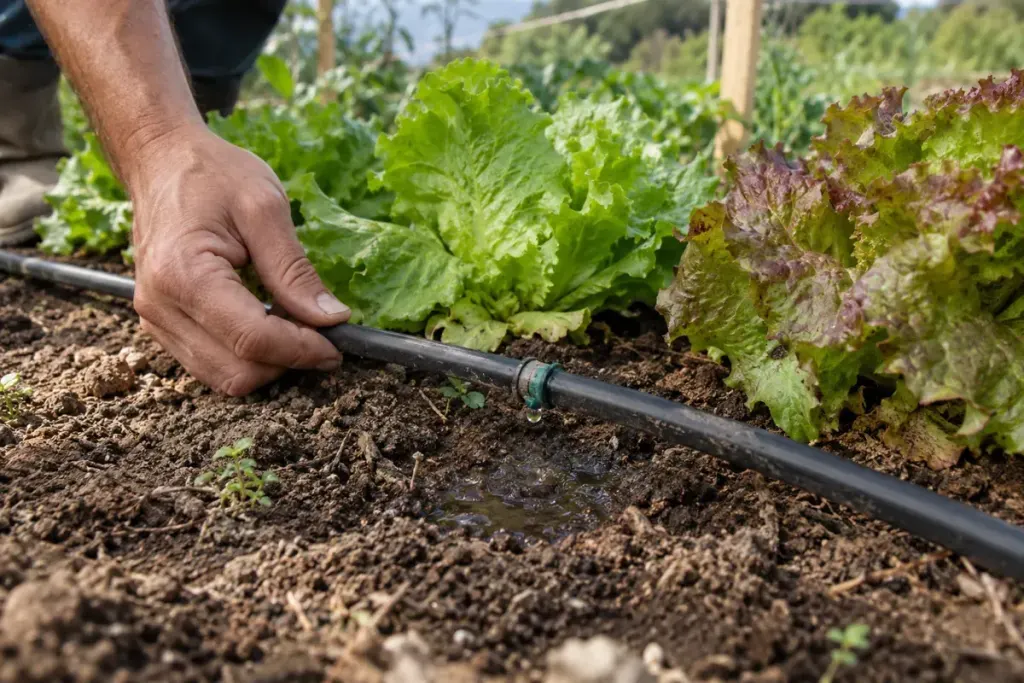
One row looks dry while another stays wet, so the timer gets a few extra minutes. That may help the first row—or simply add more water to the second. Before changing the schedule, check whether the system is delivering water where you think it is.
Drip irrigation is easy to overlook because much of its work happens close to the soil. A quick walk along the line can reveal a disconnected fitting, a pinched tube or a section that is no longer watering the intended root area.
Observe a complete operating cycle
Choose a time when the system is running and inspect the beginning, middle and far end of each zone. Note obvious leaks, damaged tubing and emitters that appear inactive. Look around individual plants rather than relying on one wet patch near the tap.
Utah State University Extension’s backyard drip-irrigation guide explains the importance of filtration, pressure and regular checks for clogs. Its advice provides a starting point; follow the specifications for the equipment installed on your site.
Compare like with like
If you measure emitter output, compare units of the same rated type over the same interval, using a method suitable for that emitter. A line that intentionally contains different flow ratings will not produce identical quantities everywhere. Mark any changed components so future checks do not assume the whole zone is uniform.
For a small illustrative test, choose matching emitters near the supply and near the end. Record the time, the collection method and any visible obstruction. A difference is a reason to investigate the system; it does not by itself identify the exact cause.
Deal with the system before the schedule
Check that filters, pressure regulation and connections match the manufacturer’s requirements. Shut off the supply before opening components. Flush or service the equipment according to its instructions, and replace damaged or unsuitable parts. Do not force a sharp object into an emitter if the maker does not recommend that method.
Where a system repeatedly loses uniformity, ask an irrigation specialist to examine the design, water quality and operating pressure. Adding runtime cannot reliably correct a layout that distributes water poorly.
Read the soil as well as the pipe
A working emitter is only one part of the picture. Soil, crop development, recent rain and weather affect irrigation needs. Check moisture using a consistent method appropriate to your growing system and compare observations at more than one location. The surface alone may not describe conditions around the roots.
Keep a short log: date, zone, equipment issue, repair and what you observed afterwards. Adjust scheduling from the crop’s needs and local guidance once delivery is understood. That gives every later timer change a reason you can revisit, rather than making a longer watering cycle the default answer to every dry-looking plant.
Continue exploring: Your Soil Sample Is Only as Useful as the Way You Collect It.