
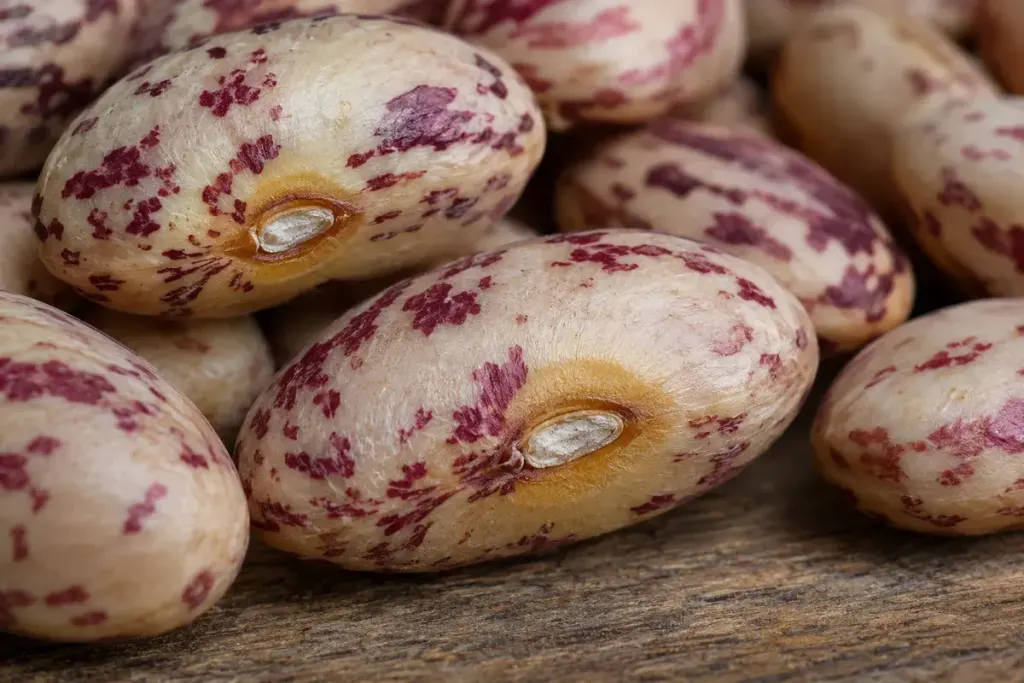
A dry bean often has a small contrasting mark along one side. It is not necessarily damage or a blemish. The mark may be the hilum: the scar left at the seed’s former point of attachment.
The Canadian Grain Commission’s seed-identification glossary defines the hilum as the scar remaining after separation from the funicle, the connecting stalk. It distinguishes this from the micropyle, a minute opening in the seed coat near one end of the hilum.
Look before soaking or cutting
Place a few familiar, untreated beans on a plain tray and use a hand lens if available. Turn each seed slowly under good light. Look for a consistent feature across several seeds of the same kind instead of deciding from one damaged specimen.
Draw a simple outline and mark what you can actually see. Label a feature as uncertain if it is too small to distinguish. An honest question mark is more useful than copying every label from a diagram onto a seed whose surface you cannot resolve.
Do not use unknown seeds or treated planting seed for a food-based activity. Keep the observation materials separate from food preparation and follow any handling information on the packet.
A visible feature is not a viability result
Knowing where the hilum sits can improve your description of a seed. It does not show whether the embryo is alive, whether storage conditions were suitable or how many seeds in a batch will germinate.
If the practical question is whether to sow an old packet, record its identity, storage history and any appropriate germination check separately. Do not replace that assessment with a confident judgement about the colour of the scar.
For a growing notebook, photograph the same seed from more than one side and include a scale. Then compare seeds from a clearly identified species. The exercise turns a tiny mark into a trace of development: a seed was once connected to the parent plant, and its surface still records that connection.