
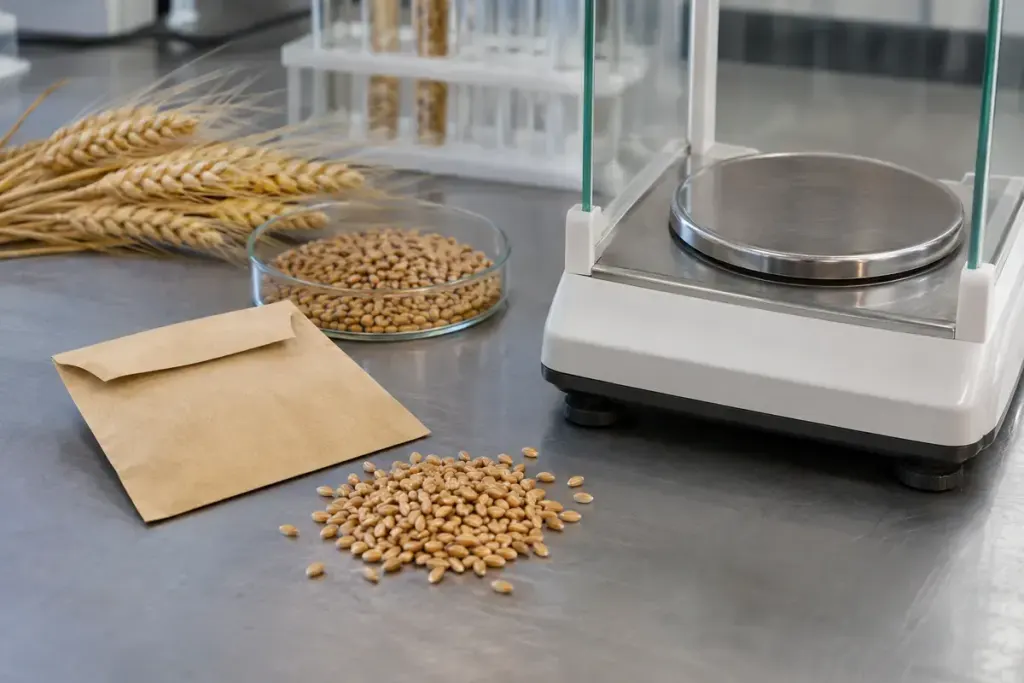
Two bags of wheat seed can weigh the same while containing different numbers of grains. Larger grains account for more of the bag’s mass. Thousand-grain weight, often written TGW, makes that difference visible in a useful calculation.
AHDB describes grain weight as one of the components used to understand wheat yield. For seed planning, the same mass-per-count idea helps connect kilograms with the number of seeds being sown. Use a representative measured value for the seed lot rather than assuming all lots are alike.
Follow the units through an example
Suppose, purely as an illustration, that one thousand seeds weigh 40 grams. One kilogram contains 1,000 grams, so the approximate count is 1,000 divided by 40, multiplied by 1,000: 25,000 seeds.
If a different lot has a TGW of 50 grams, the same kilogram contains about 20,000 seeds. These figures demonstrate the arithmetic; they are not recommended sowing rates for a field or variety.
When measuring a sample, record the number counted and the mass, then scale the result to one thousand grains. A balance with suitable resolution and a representative sample matter. Counting a handful of unusually large grains will not describe the whole bag fairly.
A seed count is not a plant count
Germination, field establishment, sowing conditions and the crop plan remain separate considerations. Do not assume that every seed counted will become an established plant. Seek local agronomic advice when turning the calculation into a field rate.
Keep the lot identification, TGW, germination information and calculation together. This makes it possible to check why a rate was selected or revise it when a different seed lot arrives. The useful result is a traceable calculation, rather than a familiar number copied from last season without checking what changed.