
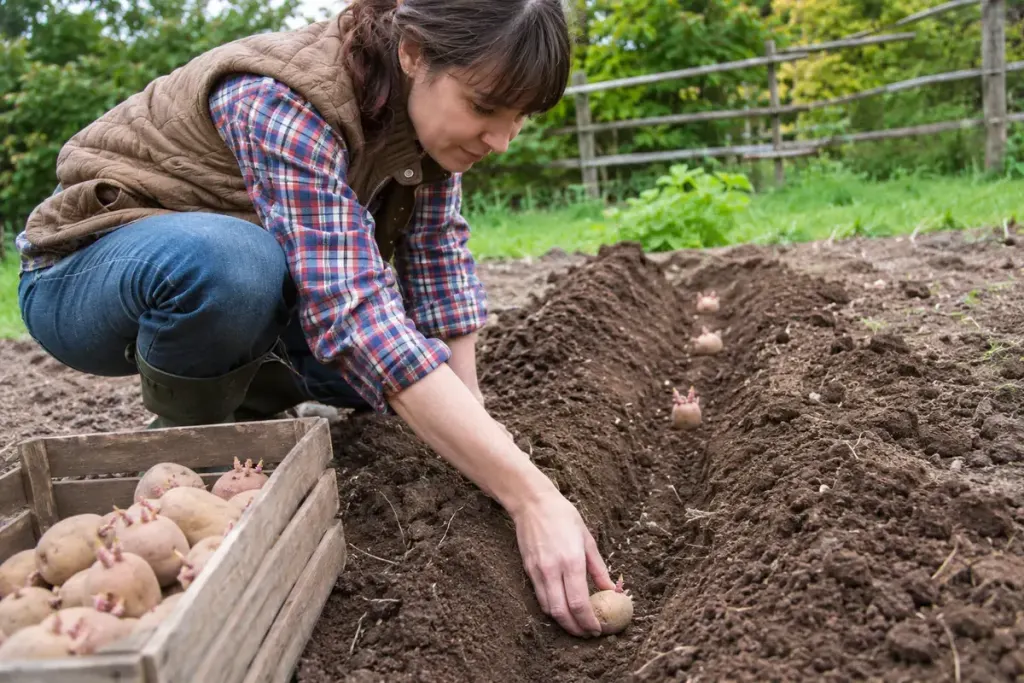
“Plant several inches deep” can leave a beginner wondering where the ruler should start. Is the instruction describing the trench, the position of the seed piece or the amount of soil covering it? Those measurements are related, but they are not interchangeable.
The University of Minnesota Extension’s potato-growing guide gives instructions for placing seed pieces, covering them and later hilling the plants. Its recommendations are written for that growing context. Reading the sequence is more useful than lifting one number out of it.
Draw the cross-section
Before planting, sketch the original soil surface, the bottom of the trench, the seed piece and the surface after covering. A seed piece has thickness, so a trench measurement does not by itself tell you exactly how much material lies above its top.
This is a measuring exercise, not a universal planting-depth prescription. Follow reliable guidance appropriate to your soil, climate, variety and growing method. If two instructions appear to disagree, check whether they are measuring the same thing and whether one describes an intermediate stage.
For a simple garden record, write “soil cover above seed piece” when that is what you measured. Avoid a bare note such as “depth: 10 cm,” which can become ambiguous when you review the crop months later.
Initial cover and later hilling are different stages
Hilling adds soil around the growing plants later. Minnesota Extension explains its role in keeping shallow developing tubers from exposure to light. A final mound height should therefore not be mistaken for the amount of cover required at the first planting step.
Keep enough information to understand the sequence: planting date, initial arrangement and any later additions of soil. There is no need to dig up growing plants repeatedly just to check a note.
If you are comparing two beds, use the same definitions in both records. Clear measurements make it easier to discuss the result with a local adviser and avoid blaming a planting method for a difference that was actually just a different way of describing depth.