
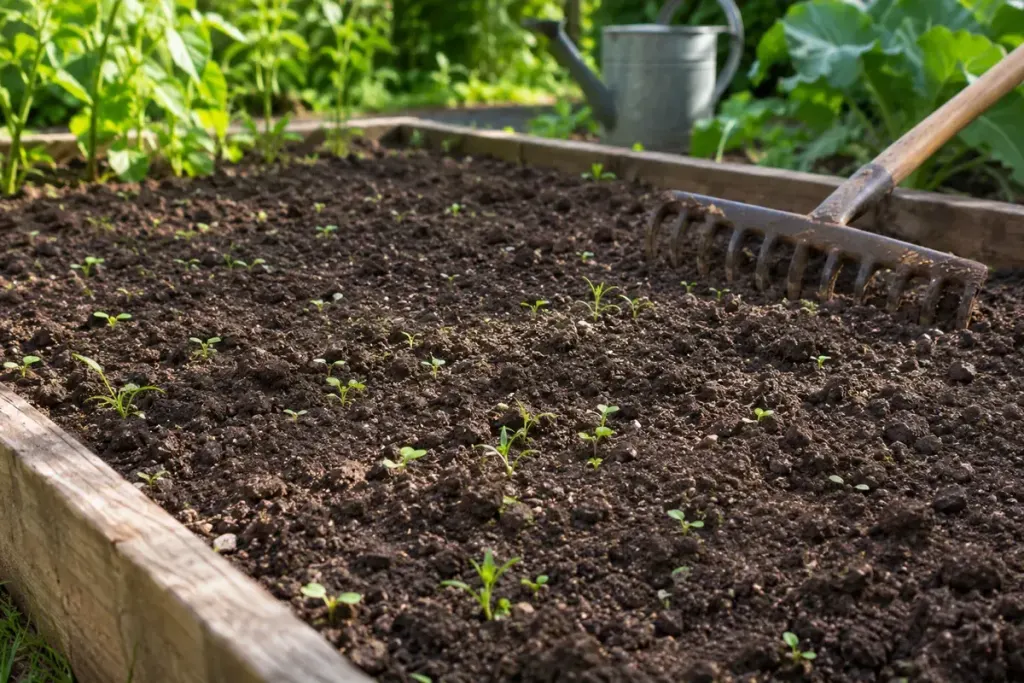
A freshly prepared vegetable bed may look clean while containing plenty of weed seeds ready to germinate. A false seedbed deliberately uses that first flush before the crop is sown, so the emerging weeds can be removed without competing with young crop plants.
The method exchanges some preparation time for an opportunity to reduce early competition. It is not a promise of a weed-free season, and it does not address every kind of perennial weed.
Let the unwanted seedlings show themselves
The University of Minnesota’s guide to reducing tillage in vegetables describes the related stale-seedbed approach: prepare before planting, allow an initial weed flush, then control it before establishing the crop. Terminology varies between guides; a false seedbed specifically uses shallow cultivation to remove seedlings.
SARE’s discussion of physical weed management emphasises limiting subsequent disturbance in related seedbed approaches. Deeply reworking the soil can bring another set of seeds into favourable conditions, undermining the advantage you were trying to create.
Plan backwards from the crop
Choose a small bed where the crop’s planting date allows preparation in advance. Record when the surface was prepared, when weeds emerged, and how they were removed. Use a suitable shallow method while seedlings are small, taking care not to turn the whole bed over again.
If cold or dry conditions produce little emergence, an empty-looking bed does not prove that the weed seed supply has been exhausted. The conditions may simply have delayed it. Likewise, a deep-rooted perennial returning from underground parts presents a different problem from a newly germinated annual.
For a useful local comparison, keep notes on crop establishment and later weeding time in similar beds. Weather, previous management, and weed species can change the outcome, so do not attribute every difference to the seedbed technique.
A practical success might be fewer weeds competing during the crop’s most vulnerable early growth, even if some later weeding remains. Judge the method by that purpose and the time it costs in your planting schedule, rather than expecting a single preparation step to replace the rest of the season’s management.