
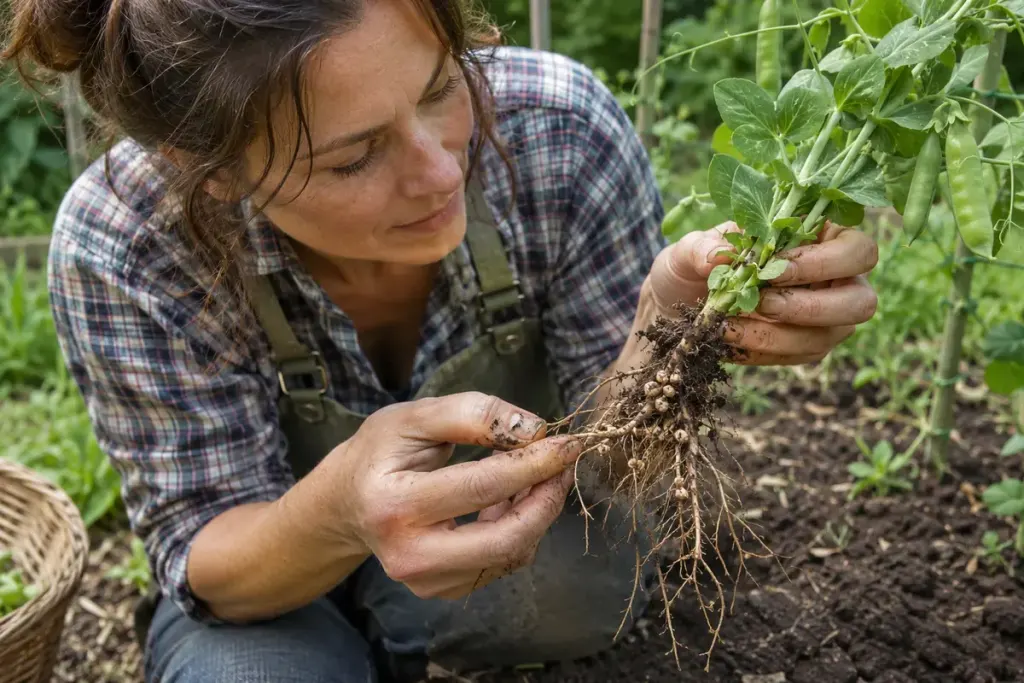
Small swellings on a legume’s roots can be part of a useful partnership rather than a sign that every root is diseased. Nodules can house bacteria involved in fixing nitrogen, but their presence needs to be interpreted with the crop and growing conditions in mind.
Penn State Extension’s guide to legume inoculation describes the relationship between legumes and rhizobia. The plant supplies carbohydrates, while the nodule supports the nitrogen-fixing process. Active nodules commonly show a pink or reddish interior associated with leghemoglobin.
Observe a sample without turning it into a diagnosis
If checking nodulation is appropriate for the crop, follow local extension guidance on sampling and timing. Lift a sample carefully rather than pulling until the fine roots and nodules break away. Record the crop, growth stage and conditions so the observation has context.
Look at distribution and condition as well as colour. A photograph of a single swelling cannot establish the health of the whole crop. If the roots look abnormal or the crop is struggling, seek identification and advice from a suitable local agricultural service.
Do not assume that adding any inoculant will suit any legume. The crop, bacterial strain, product handling and existing soil population matter. Use a product and method recommended for the particular crop and region.
The next crop does not receive all the nitrogen automatically
Some nitrogen is removed when plant material is harvested. The amount remaining for a later crop depends on the legume, its growth and what stays in the field. Nodules are therefore not a direct reading of fertiliser savings or proof that a following crop needs no nutrient planning.
Keep nodulation observations alongside soil information, crop history and local recommendations. The most useful question is whether the partnership is developing as expected under these conditions—not whether every visible nodule can be counted as a fixed quantity of free fertiliser.