
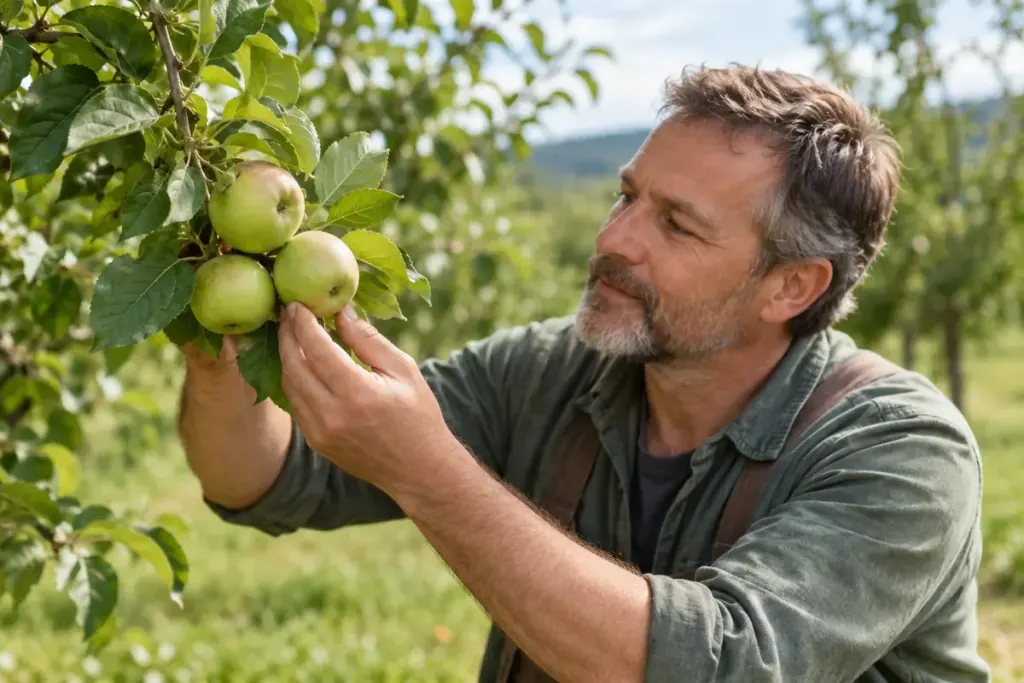
Removing healthy-looking young apples can feel wasteful. Yet a tree carrying an excessive crop may produce many small fruits and put heavy strain on its branches. Thinning is a deliberate choice about the crop the tree will carry to maturity.
The Royal Horticultural Society’s fruit-thinning guide explains why growers remove excess fruitlets and distinguishes the needs of different fruits. Its calendar is written for UK conditions; use the tree’s development and local growing advice when working in another climate.
Assess before you remove
Notice whether the tree is shedding some fruit naturally. For a beginner, waiting until this natural early-season drop has passed can make the remaining load easier to judge. A poor initial set may leave little reason to thin at all.
Look along the branch, not just at one crowded cluster. Consider the cultivar, tree age, branch strength and the intended fruit size. Cooking and dessert apples need not be thinned to the same spacing, so use cultivar-appropriate guidance rather than one universal distance.
Remove damaged, misshapen or poorly positioned fruit first. Work carefully so that taking one fruitlet does not pull off the whole spur or damage the neighbouring fruit. Use clean, appropriate tools where recommended and keep your footing secure.
Before beginning, take a photograph of two representative branches. After a small section, pause and compare the distribution. This is a practical way to avoid becoming so focused on individual clusters that you remove too much across the tree.
Do not interpret every falling apple as normal thinning. Drought, pests, disease and other problems can also cause fruit drop. Examine affected fruit and seek local advice if the pattern is unusual or accompanied by other damage.
Keep a short seasonal note of flowering, natural drop, thinning and harvest quality. Over several seasons, that record can help you understand the particular tree better than copying a neighbour’s exact count.
The aim is a manageable, well-spaced crop. It is not to make every branch look identical or to guarantee that each remaining apple will reach a particular size.